
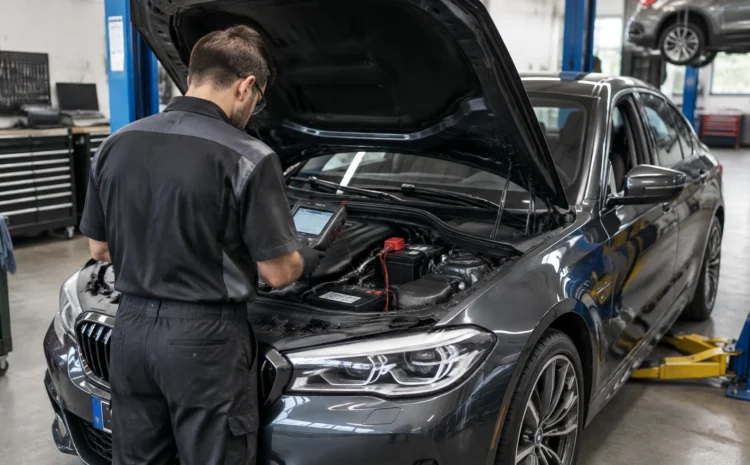
Why Does Your BMW, Audi, or Mercedes Battery Keep Dying? The Truth About Parasitic Drain
You charge the battery, get the car started, and assume the problem is solved. Then, a day or two later, you turn the key or press the start button and get nothing.
A battery that keeps going flat is frustrating, but replacing the battery again and again may not address the real problem. In many BMW, Audi, and Mercedes vehicles, the underlying issue is a parasitic electrical draw: current being used after the vehicle has been shut off and its systems should have gone to sleep.
Some electrical use is normal. Modern European cars contain numerous control modules, security systems, comfort features, and connected electronics. The important question is whether those systems shut down properly. If one remains active, the battery may discharge overnight or over several days.
For drivers searching for BMW repair Pacifica CA, Mercedes repair Pacifica CA, or Audi repair Pacifica CA, understanding the difference between a weak battery and an electrical drain is the first step toward a lasting repair.
What is parasitic drain?
Parasitic drain is the continued use of battery power when the ignition is off and the vehicle is parked. Every car has a small amount of standby draw. The battery may continue supplying power to the alarm, memory settings, security system, and certain control modules.
That normal draw should be limited once the car enters sleep mode. A problem develops when a module, light, accessory, or electrical component continues consuming more power than intended.
The result can be:
- A battery that is dead after sitting overnight
- Slow cranking after the vehicle has been parked for a few days
- Repeated jump-starts
- Warning messages or unusual electrical behavior
- A new battery that fails much sooner than expected
European vehicles can be particularly challenging to diagnose because several systems communicate with one another. A fault in one module may prevent other modules from shutting down, making the source of the drain less obvious.
Common reasons a European car battery keeps dying
A control module fails to go to sleep
When you switch off your BMW, Audi, or Mercedes, the vehicle does not always shut down instantly. Its modules may remain active for a period while they complete tasks and prepare for sleep mode.
An infotainment unit, telematics system, comfort-access module, body-control module, or navigation system can sometimes remain awake because of a software fault, internal failure, communication problem, or false signal from another component.
A module that stays active may not produce an obvious warning on the dashboard. The car can appear completely normal while quietly drawing power from the battery.
Aftermarket accessories are wired incorrectly
Aftermarket equipment is a common source of battery drain. A dash camera, audio amplifier, alarm, remote starter, GPS tracker, OBD device, or phone charger may be connected to a circuit that remains powered after the ignition is switched off.
Even accessories that worked properly for months can become a problem if wiring deteriorates, a control unit fails, or the accessory’s power-management feature stops working.
Before testing, think about anything added to the vehicle after it left the factory. A hardwired dash cam or plug-in diagnostic device is especially important to mention to your technician.
Comfort and convenience components develop faults
European cars contain many convenience features designed to make daily driving easier. Keyless entry, power liftgates, soft-close doors, power seats, trunk modules, and interior lighting all depend on switches and control units working correctly.
If a door or trunk latch reports that the vehicle is still open, the car may keep related systems awake. A faulty handle, latch, sensor, or comfort module can therefore create a drain without leaving a clear physical clue.
This is one reason professional diagnosis matters. The visible symptom may be a dead battery, while the actual cause is several systems away from the battery itself.
A trunk or glovebox light stays on
A small bulb can discharge a battery if it remains illuminated for hours. Trunk, glovebox, vanity-mirror, and interior lights are easy to overlook because you may not see them while the vehicle is closed.
A misaligned latch or worn switch can keep the light on even though the trunk or glovebox appears shut. Some newer vehicles use LED lighting and electronically controlled modules, but the principle is the same: a light or circuit that stays active can contribute to an overnight drain.
The battery is aging or has been damaged by repeated discharge
Not every dead battery is caused by parasitic drain. Batteries lose capacity as they age, and repeated deep discharges can shorten their useful life. A battery may show acceptable voltage after charging but still fail a proper load or conductance test.
A weak battery can also make an electrical problem appear worse. It has less reserve capacity, so a relatively modest draw may leave it unable to start the vehicle.
For this reason, battery testing should be performed before a technician begins replacing modules or pulling fuses. The battery must be known to be healthy enough for the rest of the diagnosis.
The charging system is not replenishing the battery
An alternator, voltage regulator, belt, cable, or connection problem can leave the battery undercharged. If the vehicle is driven mostly for short trips, the alternator may not have enough time to replace the energy used during starting and normal operation.
Charging-system issues may cause symptoms similar to parasitic drain:
- The car starts with a jump but later struggles again
- Headlights or interior lighting appear weak
- Electrical warnings occur while driving
- The battery repeatedly tests low after use
- The vehicle stalls or has difficulty restarting
A complete evaluation should check the battery, charging output, cables, grounds, and key-off current rather than assuming one component is responsible.
Why Pacifica driving conditions can matter
Pacifica’s coastal environment can expose vehicles to moisture and salt air. That does not automatically cause a battery drain, but corrosion or moisture at an electrical connector, ground point, battery terminal, or wiring connection can create resistance and communication problems.
If a vehicle is parked outdoors near the coast, an inspection may include checking visible terminals, grounds, connectors, and areas where moisture could affect electrical connections. These checks are especially useful when the symptoms are intermittent or change with weather conditions.
How a professional parasitic-draw diagnosis works

A proper diagnosis is more involved than connecting a charger or installing another battery. At a European auto repair shop in Pacifica, the process may include several steps.
1. Verify the battery and charging system
The technician first checks the battery’s state of charge and overall condition. A load or electronic battery test can help determine whether it can deliver enough current to start the engine.
The charging system is then evaluated with the engine running. This helps separate a weak battery from an alternator or voltage-regulation problem.
2. Allow the vehicle to enter sleep mode
The vehicle must be prepared as it would be when parked normally. Doors, trunk, and hood switches have to be accounted for, and the key fob may need to be kept away from the vehicle.
Modern BMW, Audi, and Mercedes systems can take time to shut down fully. Opening a door, unlocking the car, or pressing a button may wake the modules and restart the sleep process. Measuring too early can produce a misleading result.
3. Measure the key-off current
A technician uses specialized electrical test equipment to measure how much current the vehicle draws after its systems should be asleep. A sensitive current clamp or another suitable testing method can help reduce the risk of disturbing the vehicle’s electronics.
The expected reading varies by vehicle and equipment level, so there is no single number that applies to every model. What matters is whether the draw remains higher than the manufacturer’s expected standby level after the vehicle has completed its shutdown sequence.
4. Isolate the circuit causing the draw
Once an excessive draw is confirmed, the technician traces it to a circuit. This may involve checking fuse circuits, reviewing scan-tool data, observing module activity, inspecting accessories, and testing individual components.
A fuse that causes the current to drop can identify the affected circuit, but it does not necessarily identify the failed part. Several components may share one fuse, so further testing is often needed before recommending a repair.
5. Confirm that the repair worked
After the suspected fault is repaired or disconnected, the vehicle should be tested again. The car must complete its normal sleep cycle, and the key-off current should be checked a second time.
This confirmation step is important. Without it, replacing a component may only appear to solve the problem temporarily.
Why replacing the battery alone may not solve it
A new battery can hide a parasitic drain for a short time because it has more available capacity than the old one. However, if the vehicle continues drawing excessive current while parked, the replacement battery will eventually discharge too.
Repeated deep discharges can damage the new battery, leaving you with two problems instead of one: the original electrical fault and a battery that no longer holds a reliable charge.
That is why the most cost-effective approach is usually to diagnose the cause before authorizing another replacement. Accurate testing can prevent unnecessary parts and help you make an informed repair decision.
Specialized electrical diagnosis without dealership prices
European vehicles benefit from technicians who understand their electronic architecture, diagnostic procedures, and OEM requirements. European Motor Werks provides a dealership alternative for drivers throughout Pacifica and the San Francisco Bay Area, with ASE-certified technicians and more than 40 years of combined experience.
The goal is not to replace parts based on a guess. It is to identify whether the problem involves the battery, charging system, wiring, accessory, light, or control module and provide an honest estimate for the work that is actually needed.
If you need European car repair Pacifica drivers can rely on, learn more about European Motor Werks’ diagnostic approach or explore the shop’s European vehicle services.
Stop chasing the symptom
A BMW, Audi, or Mercedes that repeatedly needs a jump-start is giving you useful information. The battery may be aging, the charging system may be underperforming, or an electrical circuit may be staying active after the vehicle is parked. Replacing the battery without testing the full system can leave the real problem untouched.
European Motor Werks can help identify the cause with specialized diagnostics, careful testing, and a straightforward explanation of the repair options. Schedule a battery and electrical diagnostic inspection today so you can stop guessing: and get back to starting your vehicle with confidence.